iPaybetter
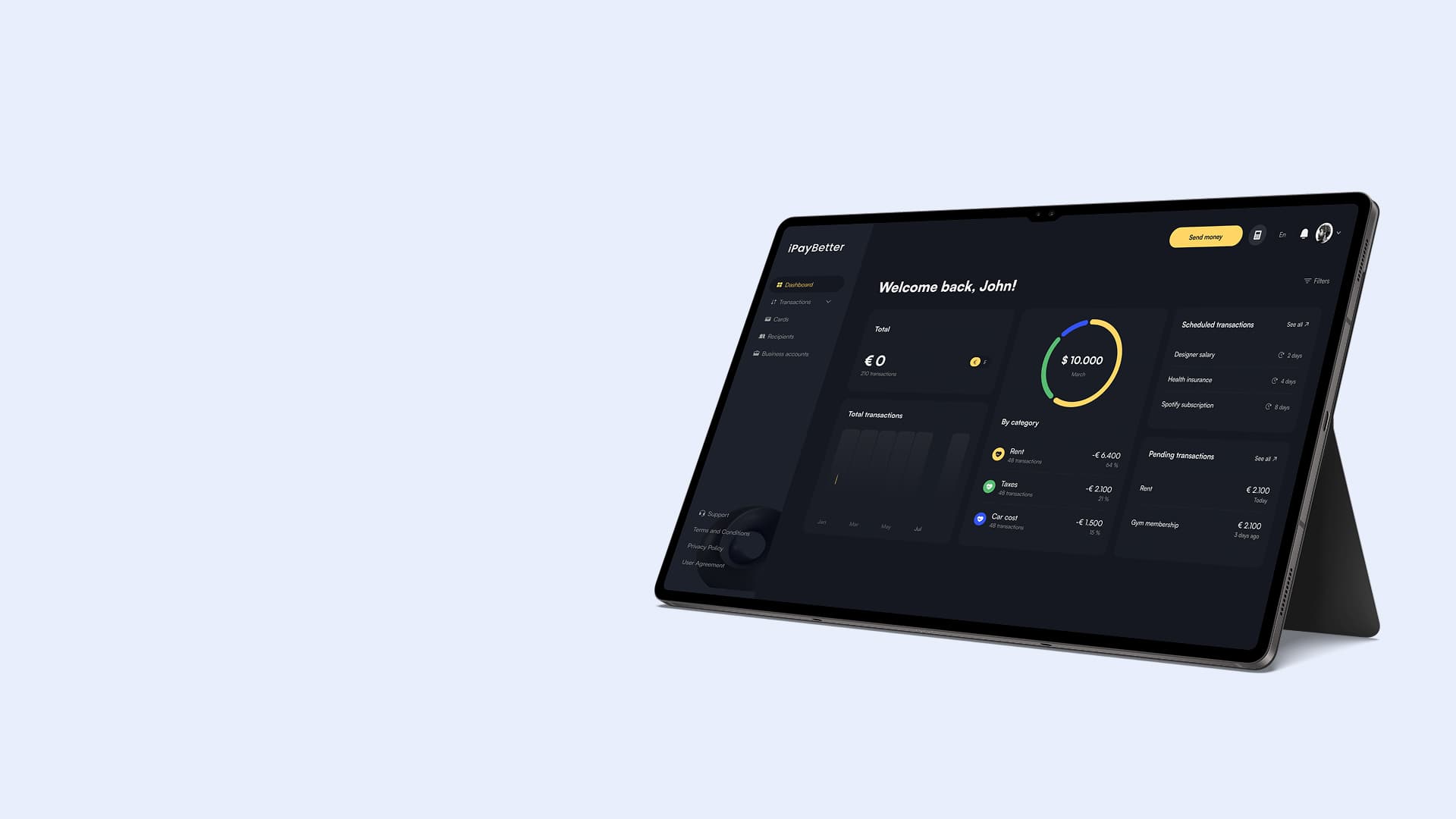
iPayBetter lets anyone pay a bill with a credit card, even when the recipient accepts only bank transfers. Payments that would normally require an IBAN transfer can be paid with a Visa, Mastercard, or American Express card. The payer earns points and miles and gains up to 58 days of interest-free liquidity through the card's billing cycle; the recipient simply receives a normal bank transfer.
Redberry designed and built iPayBetter from the ground up in 2022 and delivered the MVP in four months. The platform has since grown into a regulated Swiss financial intermediary. iPayBetter is affiliated with the VQF and operates under the Swiss Anti-Money Laundering Act. As the long-term engineering partner, Redberry built the product to be compliant by design - architecting onboarding, payment processing, and monitoring around KYC, KYB, and transaction-level AML screening - and set the platform up to scale.
 ipaybetter.com
We are responsible for





The heart of the product is a card-to-IBAN transfer. A user saves a recipient's bank details once - a landlord, a tax office, an insurer, a contractor - chooses a saved card, enters an amount, and sends. iPayBetter charges the card and pays the recipient by ordinary bank transfer, carrying the user's reference or payment purpose so the money arrives looking exactly like a normal transfer. This works for rent, utilities, insurance, salaries, taxes, tuition, medical bills, and general business expenses: precisely the payments that normally refuse cards. Every transaction earns the card's points or miles and defers the actual outlay by up to 58 days, turning unavoidable bills into rewards and working capital.


Registration is a compliance gateway, not a form. iPayBetter supports three account types - individual, business, and sole proprietor - each with its own registration requirements and verification path through SumSub. Individuals and sole proprietors complete KYC with document and liveness checks; businesses complete KYB, including company-registration verification, ultimate-beneficial-owner identification, and representative verification. Politically-exposed-person and sanctions screening run as part of every check, and each applicant receives a risk score that follows them into transaction monitoring. A user becomes able to transact only once their email is confirmed and their identity is approved, so the platform never moves money for an unverified party.


Compliance continues on every payment, not just at signup. When a payment is created, funds are reserved on the card, and the transaction - amount, currency, payer, counterparty, payment method, and purpose - is submitted for Know Your Transaction screening. An approved result charges the reserved amount and proceeds to payout; a rejected result releases the funds and notifies the user; an on-hold result pauses the payment for review. Rejection reasons are retrieved and stored, every screening event is retained against the transaction, and an operations team works flagged and undefined transactions from a dedicated monitoring console. The result is an AML posture that is enforced automatically and defensible on audit, which is exactly what a VQF-supervised intermediary needs.


Before a payment is screened, its invoice is checked by an AI agent. iPayBetter asks users to attach the invoice behind a payment, and the agent uses an AI vision model to read it and extract the recipient name, IBAN, amount, currency, and purpose. The extracted data is compared against what the user entered: a clean match auto-approves the payment and passes it to processing, a discrepancy routes it to manual review, and a clear mismatch blocks it and tells the user why. This catches fraud, typos, and misdirected transfers before money leaves the card, and it gives compliance a documented reason behind each accepted payment.


Single, Scheduled, and Recurring Payments
iPayBetter handles one-off payments, future-dated payments, and fully automated recurring payments for regular obligations like rent or insurance. Recurring schedules are driven by the Laravel scheduler, spawn individual payments through the same screening and payout pipeline as manual ones, and can be cancelled at any time. Recipient management, saved card profiles, a transaction history with downloadable receipts, and an expenses overview round out the day-to-day surface, so a user's entire bill-paying life sits in one place.


Multi-Currency, Multi-Rail Processing
The platform operates in Swiss francs and euros and accepts Visa, Mastercard, and American Express. The payment layer is provider-agnostic by design: a payment-gateway factory selects an acquirer by currency (for example, Datatrans for CHF and Payrexx for EUR), while a bank-provider abstraction routes payouts to any IBAN through whichever banking rail is configured (for example, Revolut Business or the Swiss bank HBL). New acquirers and bank partners can be added behind the same interfaces without touching the payment flow. Provider webhooks are signature-verified and processed idempotently, batched payouts are reconciled against downloaded bank statements, and a fee engine calculates provider, platform, and payout fees per transaction, reconciling estimates to actuals once a payout settles. The complexity of multi-rail money movement stays entirely behind a single transparent price the user sees before they confirm.

Business Accounts and iPayBetter Plus
Beyond individuals, iPayBetter serves companies and sole proprietors with their own onboarding, fee structures, and business-payment surfaces, including a KYB verification fee and enhanced bank-information requirements once a business passes defined transaction thresholds. An iPayBetter Plus subscription lowers the per-transaction fee for both private and business customers. Account eligibility, verification state, fees, and subscription status are all modeled explicitly, so the same payment engine serves a renter paying rent and a company paying suppliers under different commercial terms.

Operations Console, Reconciliation, and Reporting
Running a regulated payments business requires an operational back office as capable as the customer app. Redberry built iPayBetter's admin on Filament, giving compliance and finance teams transaction monitoring, business-account payment management, recurring-payment oversight, invoice review, reconciliation against third-party and bank data, and financial reporting. This is where suspicious transactions are worked, discrepancies are caught, and the numbers behind the platform are made auditable.
Involvement & Process

Meet the authors
We are a 200+ people agency and provide product design, software development, and creative growth marketing services to companies ranging from fresh startups to established enterprises. Our work has earned us 100+ international awards, partnerships with Laravel, Vue, Meta, and Google, and the title of Georgia’s agency of the year in 2019 and 2021.



Latest News
.webp&w=1920&q=75&dpl=dpl_6FMi6fcgDWWDk89oNyqzG3wU3q9j)
Laravel Meetup Georgia Returns October 8, with Nuno Maduro in Tbilisi
The second edition of Laravel Meetup Georgia is on Thursday, October 8, at 18:00, on the Stamba rooftop in Tbilisi.

Twelve Years of Redberry: From Four Friends in Tbilisi to a Laravel Premier Partner
Redberry is twelve. What began in 2014 with four founders in Tbilisi now rests on two decisions taken along the way: specialise in Laravel, and take that expertise international. That adds up to 300+ products shipped across the EU, UK, US and Middle East, around 200 people, and a place among the 13 Laravel Premier Partners worldwide. Here is how we got here, and who got us here.

Applications Are Open for the 12th Batch of Our Laravel + React Bootcamp
Our free four-month Laravel + React Bootcamp is back for a 12th batch - now AI-assisted. Applications are open until September 27.

Financial Services | Protection Insurance

SaaS Application